![]() |
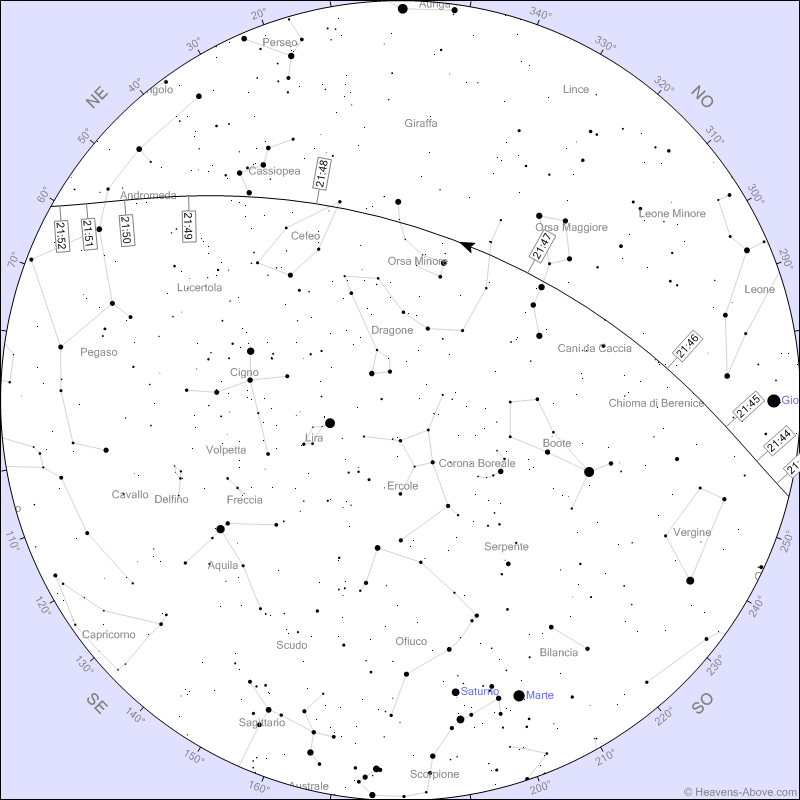
| La mappa del cielo con il passaggio dell'ISS |
![]() |
| La SpaceX Dragon . foto NASA |
![]() |
| La SpaceX Dragon vista dall'ISS pochi istanti prima del contatto . foto NASA |
Appunti di ricerca e sperimentazione amatoriale di Giorgio De Luca IU3IOU (SWL I-4979/VE) - Cornuda (TV) ITALY
![]() |
| La mappa del cielo con il passaggio dell'ISS |
![]() |
| La SpaceX Dragon . foto NASA |
![]() |
| La SpaceX Dragon vista dall'ISS pochi istanti prima del contatto . foto NASA |
![]() |
| Paolo Nespoli (in basso a sinistra) nelle prime immagini dopo l'arrivo sulla ISS |
ARISS ha recentemente pianificato un nuovo evento di sperimentazione delle comunicazioni nella modalità Slow Scan Television (SSTV), modalità con cui vengono inviate immagini dalla Stazione Spaziale Internazionale ISS tramite apparecchiature radioamatoriali e ricevute da radioamatori ed ascoltatori sulla Terra.
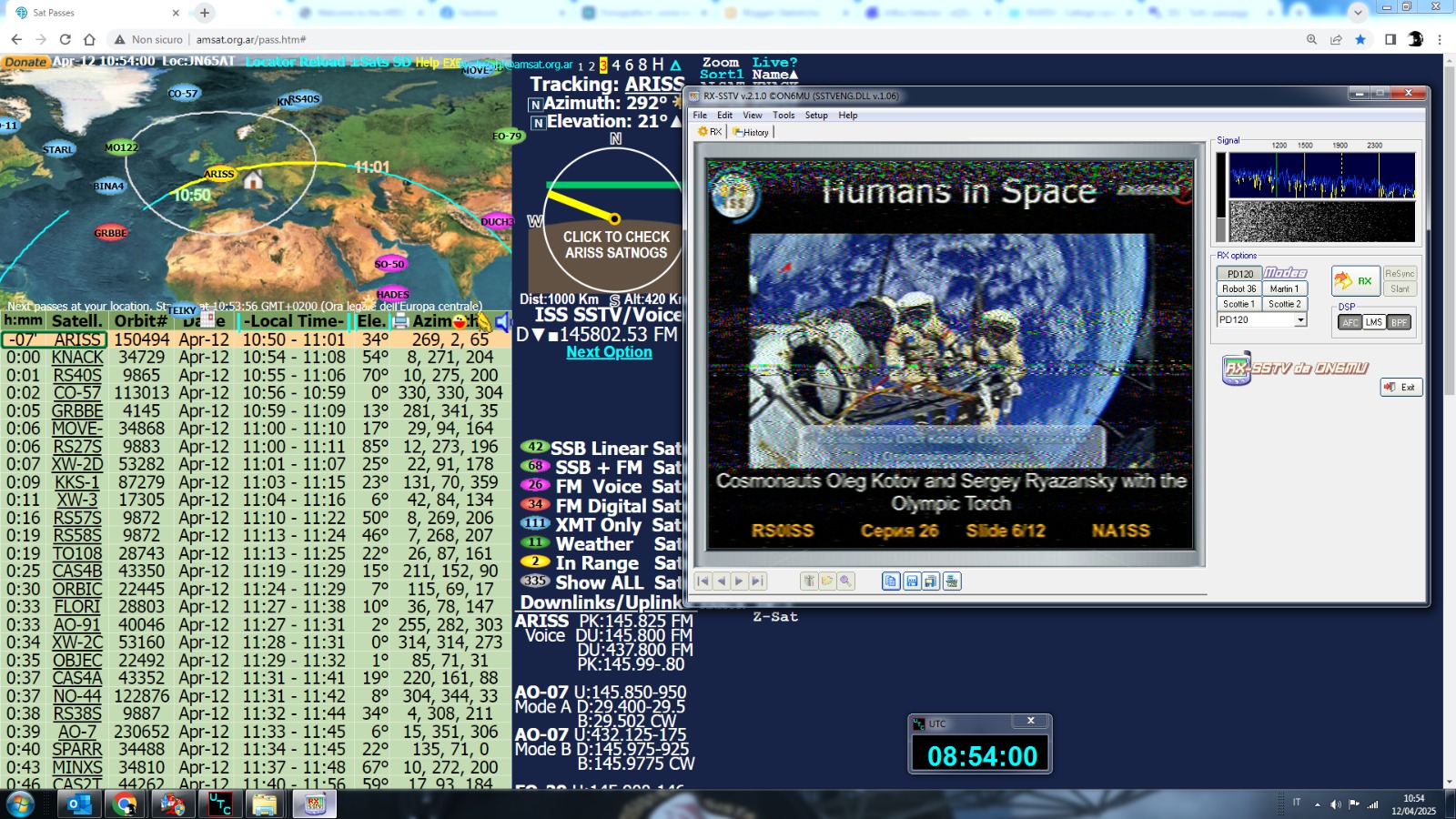
Le trasmissioni di immagini sono state trasmesse sulla frequenza della Stazione Spaziale Internazionale ISS di 145.800 MHz e la modalità SSTV - PD120.
Anche in questa occasione mi sono cimentato nella ricezione delle immagini SSTV inviate dalla Stazione Spaziale Internazionale ISS, seguendo anche l'orbita grazie ai vari servizi on line.
Grazie alla ricezione delle immagini in modalità SSTV ho conseguito un nuovo ARISS SSTV Award.
Hello,
Thank you for submitting your report. This time, SSTV images are broadcast on the occasion of International Day of Human Spaceflight. April 12 is the anniversary of the first human flight into space (Yuri Gagarin – 12 January 1961). The diploma features the figure of Yuri Gagrin and his spacecraft Vostok – 1. SSTV images depict various events related to the human sojourn in space.
Amateur Radio on the International Space Station (ARISS) is a cooperative venture of international amateur radio societies and the space agencies that support the International Space Station (ISS). The primary goal of ARISS is to promote exploration of science, technology, engineering, the arts, and mathematics topics. ARISS does this by organizing scheduled contacts via amateur radio between crew members aboard the ISS and students. Before and during these radio contacts, students, educators, parents, and communities take part in hands-on learning activities tied to space, space technologies, and amateur radio.
Setup di ricezione
RTX ICOM IC-746
Antenna Diamond X300A
Software RX SSTV
Cieli sereni.
73 de Giorgio IU3IOU
Link ad articoli nel blog inerenti la Stazione Spaziale Internazionale ISS (link)
![]() |
| L'orbita dell'ISS monitorata con il software Orbitron |
ARISS ha pianificato per questo periodo un altro dei suoi famosi eventi di esperimento nella modalità Slow Scan Television (SSTV), modalità con cui vengono inviate immagini dalla Stazione Spaziale Internazionale ISS tramite apparecchiature radioamatoriali e ricevute da radioamatori ed ascoltatori sulla Terra.
Le trasmissioni di immagini sono state trasmesse sulla consueta frequenza della Stazione Spaziale Internazionale ISS di 145.800 MHz e la modalità SSTV - PD120.
Anche io come molti altri appassionati mi sono cimentato nella ricezione delle immagini, con risultati non del tutto soddisfacenti dal punto di vista qualitativo delle immagini ricevute.
Nonostante questo, tali ricezioni sono state sufficienti a ricevere il mio ARISS SSTV Award, con una mail accompagnatoria.
Hello IU3IOU,
ARISS Celebrating 20 Years of Continuous Operations on ISS. ARISS was established in 1996 as the successor to SAREX (Shuttle Amateur Radio Experiment on the USA Shuttles) existing since 1983. Activities onboard the International Space Station (ISS) by the space agencies: NASA, Roscosmos, ESA, JAXA, and CSA as well as AMSAT and organizations affiliated to the International Amateur Radio Union (IARU) from the countries participating in the program, began in 2000. The first test of amateur radio contacts using the HAM station on the ISS with ground stations from Russia and the United States, took place 20 years ago on November 13. In the following days, there were other communication tests, while the first successful contact of ARISS with the school took place on December 21, 2000. After that more than 1300 school ARISS contact over the World were performed using callsigns: RS0ISS, NA1SS, OR4ISS, IR0ISS, DP0ISS, FX0ISS, GB1SS, FX0STD, HL0ARISS, IZ0JPA, AB55IK, 9W2MUS, PY0AEB.
Presently after 20 years of continuous operations, ARISS volunteers carry out many amateur radio experiments: radio voice repeaters, Digital APRS repeaters, amateur radio satellites, SSTV images, ARISS activity awards, and direct audio and digital video contacts with the ISS crew. It offers students the chance to have an exciting experience – a face-to-face conversation via amateur radio with the crew members onboard the International Space Station. It activates young people's interest in STEAM and motivates them to learn.
Transmission of SSTV images from the International Space Station is possible thanks to the involvement of many people working for ARISS.
*** Happy New Year 2021 ***
https://www.ariss.org/
https://ariss.pzk.org.pl/sstv/
*****
Greetings - Slawek SQ3OOK
ARISS SSTV Award Manager
Alle prossime e cieli sereni.
73 de Giorgio IU3IOU
![]() |
| La mappa del passaggio della ISS |
![]() |
| La mappa del brillamento Iridium |
![]() |
| La mappa del passaggio dell'ISS |
| Data: | sabato 16 agosto 2014 |
| Orbita: | 413 x 419 km, 51,6° (Epoca: 16 agosto) |
| Evento | ora | Altezza | Azimut | Distanza (km) | Magnitudine | Altezza Sole |
| Sorge | 21:42:59 | 0° | 297° (ONO) | 2.357 | 2,4 | -13,7° |
| raggiunge l'altezza di 10° | 21:45:08 | 10° | 303° (ONO) | 1.493 | 1,0 | -14,0° |
| Culmina | 21:48:24 | 50° | 20° (NNE) | 542 | -2,6 | -14,4° |
| Entra nell'Ombra | 21:50:08 | 24° | 86° (E) | 917 | -2,0 | -14,7° |